Showing posts with label engineer. Show all posts

Friday, December 15, 2017

Meet Dextre the Robot

Recently on the Moth podcast I listened to On Approach to Pluto by Cathy Olkin, a scientist who worked on NASA's New Horizon's mission to Pluto.  It brought back some memories of my own flight support experiences when I was still working as an engineer for MDA, the company that built the Canadarm.  My job there for the first five or so years was focused on systems integration and testing of the Special Purpose Dexterous Manipulator (SPDM), or Dextre, which was supposed to be more media-friendly.  Note that no one called it Dextre.  

The SPDM is a two-armed robot equipped with various tools to perform repairs on the International Space Station and can be operated while attached to the end of the Canadarm.  Below you can see it at the tip of the Canadarm on the newest Canadian five dollar bill.  No, it didn't make it onto the twenty but it's still pretty awesome.  A cool and little known fact:  Many of us at MDA who worked on the SPDM were allowed (informally?) to sign our names onto the hardware just prior to it being shipped down to Florida for launch.  You can't see the signatures as they are covered by the white thermal blankets but it's a pretty neat thought to know there is something out in space with my signature on it.

Five dollar bill showing the SPDM on the tip of the Canadarm
The SPDM launched on March 11, 2008 on STS-123 and a handful of us from MDA supported the assembly and commissioning of the robot on that mission.  I was used to doing flight support for the Canadarm from the Canadian Space Agency from Montreal but it was my first time supporting operations from the Johnson Space Centre in Houston.  At that point I had yet to see a shuttle launch and the Space Shuttle program was coming to an end in 2011.  Four of us from MDA were being sent down to Houston to support the mission - one to cover each shift, and our chief engineer was a floater to be on whichever shift had the most action on a given day.  We pleaded with our managers to let us fly to Florida first to watch the shuttle launch before heading down to Houston but we were denied permission.  Launches were frequently delayed due to weather and they couldn't have us hanging around Florida when we needed to be answering last minute questions about the mission back at home.  In the end STS-123 did in fact launch as planned without delay (fist shaking at our managers) and we flew down to Houston to begin what was ultimately a successful and very eventful mission to assemble the SPDM and perform all initial checkouts.

Below is an email I dug up which I wrote from my hotel room to family and friends towards the end of that mission.  I got a kick out of reading it again today almost a full decade later.

************  Monday, March 17, 2008  ********************************************

Hey guys,

Just thought I'd share some excitement with you.  I'm more than half way through the SPDM 1J/A launch mission where I'm doing flight support from the Mission Evaluation Room (MER) in Houston.  If you've been paying attention to the news at all you'll know that we've been having loads of problems launching and installing and powering our robot SPDM (that I've tested since I started working at MDA).  

Yesterday I pulled a 15 hour shift trying to analyze data for multiple brake failures we experienced.  It got to the point where everyone involved in the mission was calling on the phones and voice loops at once wanting an explanation. I have a headset but wasn't the person who talked on the voice loops, however I supported our chief engineer from the neighbouring console. Then the Flight Director, Dana Weigal, requested a meeting with MDA Engineering (that's us!) because she needed to be convinced there wasn't a problem before she would allow the ops to continue. This doesn't normally happen because there's another level of engineering at NASA that separates us from the Flight Director but our chief engineer and I are supposedly the "experts" for this brake test on this specific robot.  

We were told we had only 40 min to put together a short presentation...and then our chief engineer and I got called into the Flight Control Room! It was SO COOL...but my hands were a bit shaky and I hadn't eaten or slept in hours.  People doing flight support from Houston and Montreal said they saw me on NASA television talking to the Flight Director.  I'm going to see if someone can get that part of the video for me since they record everything.  

After that we stayed for meeting after meeting after meeting, went back to the hotel to sleep for 4 hours and had to come back for 6 hours of more meetings to convince the Station and Shuttle managers that we were good to go and there was no impact to the mission.

Check out the email below, from the manager of the SPDM program at the Canadian Space Agency.  Pay attention to the last sentence :D This was sent out to a wide distribution in Houston, Montreal and back at Brampton.  That experience was well worth the lack of sleep over the mission so far.  I should be coming back to Toronto around Good Friday.

Danielle

*********************************************************************

I then attached an email of congratulations from Dan Rey, the SPDM program manager, who had mentioned the chief engineer and me by name for our "amazing work done in short order to avoid any impacts to the mission timeline."  

A few things I still remember from that mission:

1.  When it was time for the chief engineer and I to present to  the flight director (recall, this doesn't usually happen as the Flight ROBO typically is the middle-man between engineering and the FD) I assumed we were being led into a small meeting room and was floored when we stepped into the Flight Control Room where (obviously) the FD would be. Flash to Apollo 13 with Tom Hanks - we later toured the actual control room for that mission.

2.  While meeting with the flight director our chief engineer did most of the talking with minimal support from me.  However we happened to be standing in the path of one of the NASA cameras in a way which only had the flight director and myself in view (I later heard from colleagues who saw me on screen).  It looked like I had had a private meeting with the FD!  They never were able to pull the footage for me to see unfortunately.

3.  We had a great time riding rollercoasters at the nearby amusement park on our days off.

Eyes a little bloodshot from too many hours analyzing data

Numerous calls to troubleshoot failures during post-assembly testing

Vising the Flight Control Room again on our last day (Flight ROBO didn't look amused)
Riding rollercoasters between shifts

Friday, August 25, 2017

From Engineer to Entrepreneur

My fourth season with Bridge the Bump is about to begin which will bring with it new challenges, new successes, new failures, new lessons.  A brand new baby is also expected any day.  While enjoying the calm before the storm I read through some of my thoughts written after just the first season as a small business owner.  I'm reminded of how hard it was to venture into something different, something unknown.  I'm comforted to know that that first transition, although scary, was a good and necessary step forward and find myself more ready now to embrace the steps, transitions, and pivots that will undoubtedly come.

***********************************************
(Thoughts below written in April 2015)

After a decade of working in engineering and building what I imagined would become a lasting career, I took a leap of faith in 2014 and completely switched gears.  It seems fitting on this one-year anniversary of change to reflect on the choices I’ve made with respect to career goals, personal aspirations, and family.  The impetus for starting my own business was becoming a mother.  Being away from the office for a full year on maternity leave forced me to re-assess my identity and the value of my time as I appreciated increasingly that time truly is a precious a commodity.

I dedicated over ten years working at MacDonald Dettwiler and Associates (MDA), formerly SPAR, which is still best known for producing the iconic Canadarm for the International Space Station.  The first half of my career at MDA was really quite rewarding.  Having completed a 16-month internship there before graduation afforded me the opportunity to work directly with hardware early in my career where most of my learning took place.  I had fantastic mentors and developed a genuine excitement and enthusiasm for my job.

Showing my parents around the clean room during an Open House in 2006
On the Dextre program I was heavily involved in integration and testing and eventually took a lead role in supporting the launch and commissioning of the robot.  I constantly strived to succeed at work; university had been an extremely stressful time which had shaken my confidence due to mediocre grades, a surprising disappointment after highschool.  This job was an opportunity to restore a belief in my abilities.    I wanted to be a part of something relevant that challenged and interested me, and I wanted to excel as a female engineer.  There had been a number of young women working at MDA when I started in 2004 but eventually many left and I became aware that few women held senior roles within the company.

I took pride in my job and readily worked long hours, travelled often to support flight missions, and shadowed my mentors with curiosity.  However I realized there wasn’t really an outlet at the office for my creative energy.  Instead at home I began teaching myself some piano, practised my guitar with regularity, and in 2007 started an online jewellery side-business.


Kennedy Space Centre
The Dextre robot launched in 2008 and I provided real-time support from the Johnson Space Centre.  It was an incredibly rewarding and exciting milestone.  However in the following years opportunities at work declined as the company struggled through some harder times.  I transitioned through a number of varying shorter-duration projects where I spent more time on paperwork than problem-solving.  I became discouraged and gradually questioned my technical skills.  Often I thought about applying elsewhere but lacked the motivation.  It was disheartening to peruse job postings which made me feel unqualified, uninspired, or both.  I didn’t know what other direction to head on a professional level so I continued to work at my job and used every outside opportunity to bring balance back into my life.  This included enrolling in night classes at George Brown College in Jewellery and learning to sew on a beautiful Singer machine given to us by my husband’s grandmother.  I also started to follow craft blogs online and eventually started my own to fuel the momentum.  It was clear that these hobbies brought me joy but I never seriously believed there was a career to be found in them.

Work improved for a time but ultimately I had already lost my drive for it and treated the job as just that, a job.  Then, in 2012 I was pregnant with my son.  I was absolutely thrilled.  I fully embraced pregnancy and looked forward to having time off with my child.  This became my distraction from work.  

Maternity leave was wonderful but it was not without its struggles.  Apart from the challenges caring for a newborn there was an initial period of being disappointed with how little I could achieve in a day.  I didn’t yet appreciate that the measures of success and productivity had changed.  It took several months before I could really wind down and simply enjoy motherhood.  When I wasn’t tending to my child I would sew and post to my blog.  That’s when I started imagining the real possibility of turning my passion for sewing into a career.  

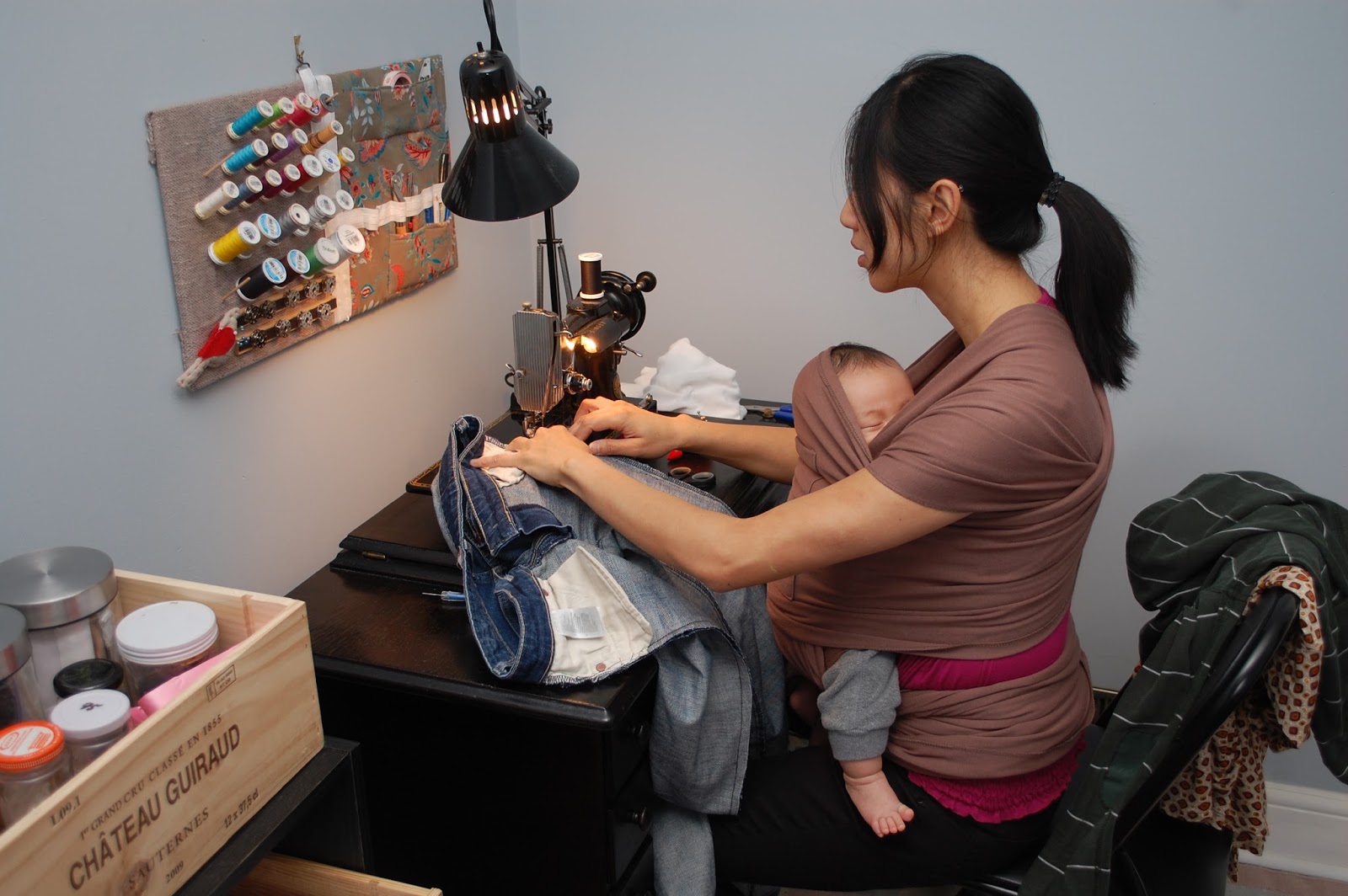
1954 Singer 222K
During our shared maternity leave my sister-in-law and I talked about starting a company together, with her expertise in marketing and my drive for design.  We discussed this with our husbands and thought it should probably wait until each family was finished with having children, possibly in two or three years.  In the meantime I would go back to engineering.

I dreaded the end of my maternity leave, finding childcare, and returning to my 40 minute- commute which easily exceeded an hour in bad weather.  Shortly before the year was up I took an interview with another engineering firm hoping that a new company might reboot my focus on a career in engineering.   I was offered a great position.  However the job would take place at a client’s site further west of the city which would equate to an even longer commute.  On top of that I started having second thoughts about trying to prove myself at a new company when so much of my attention was now focused on family.  I turned down the job.

I returned to MDA as the Systems Lead for a new space program with lots of potential.  This was a great opportunity that I didn’t appreciate at the time.  Instead of embracing the fact that management was helping me pave a path towards a senior leadership role I resented being thrown into the deep end upon my return.  It was an emotional and stressful period.  I had the responsibility of both dropping off and picking up my son since I used the family’s only car to commute to work. That translated into working through lunches or after my son was asleep at night in order to prepare for four separate project reviews within the short time I was back.   I wanted to prove to my colleagues and to myself that it was possible to have a career as a new mother but my job was taking me away from my family and my passions.  I recognized now more than ever before the value of my time which was finite and not to be taken for granted.  

After three months back on the job I handed in my letter of resignation, giving a full month of notice to help with the transition.  My mind was now set on starting my own business and spending more time at home with my son.  It was touching to see so many of my colleagues, many who were parents themselves, encourage this decision.  The company Bridge the Bump was formed shortlyafter and I was soon joined by my sister-in-law who had faced her own struggles returning to work.  Our plan to wait two to three years was scrapped.  

At Bridge the Bump we design, manufacture, and sell coat extensions that expand an existing winter coat during pregnancy or for baby-wearing.  The product is an improved variation of an extension panel I created for my own coat while pregnant with my son.  Soon after I had several requests from ex-colleagues who were also expecting a baby and wanted a similar solution for their coats.


In a startup there is no roadmap to follow and yet that doesn’t frighten me.  I have a confidence in the business to succeed which is unsupported by any relevant personal experience but rather a knowledge of how hard I work with the right motivation.  And running a business is hard, messy, often thankless work.  But there is something extremely fulfilling about designing a product from scratch and creating it with your own hands.  Each of the coat extensions sold in our first season was hand-sewn on that same beautiful Singer machine I inherited five years ago.  None of this would have been possible without the encouragement and support from my husband and closest friends.  

I structure my day as much as possible around my son’s schedule to maximize our time together.  This often results in late nights and real fatigue but aligning my passion and work has made an incredible difference in my overall happiness.  I feel like an entrepreneur, designer, creator, and mother without exclusion.

I am grateful for my experience at MDA with all that I was able to learn, to achieve, and for the friendships I formed.  Working in industry for ten years also placed me in a stronger financial position to take on this risk now in life.  However if I could pass on advice to my younger self I would say not to get stuck in the waiting place; believe in your own strength and abilities to make things happen and then take the first step, even if you have to keep changing course. 

Fertility Part 1: Two Weeks At A Time

(This letter was written over a year ago on June 6, 2016) The emotional challenge of living in 2-week intervals has finally come to an en...